
AI in Education: Why We Should Be Far More Afraid – and Far More Hopeful – Than We Are
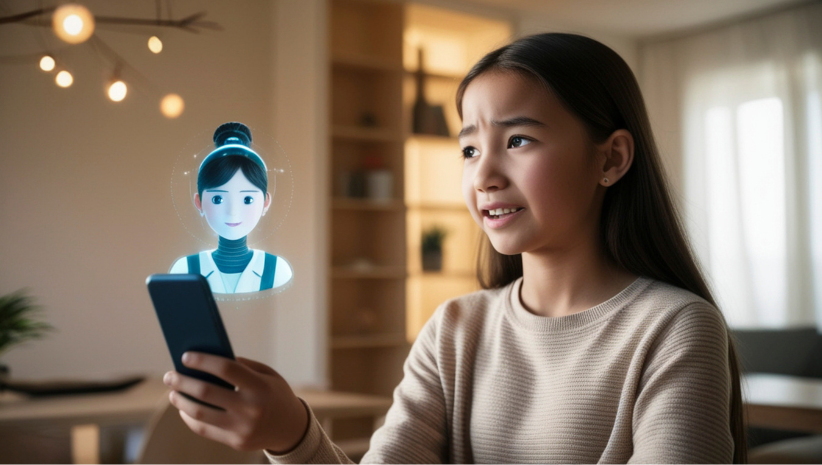
Walk into almost any secondary school today and you’ll see a quiet revolution happening behind the scenes. Teenagers aren’t whispering answers to each other anymore – they’re whispering to ChatGPT. Essays, revision notes, explanations, translations, even friendship dilemmas… AI has become the new mentor in the room. And while many adults are shrugging with a weary “well, this is the future,” I want us to pause and ask a harder question:
What future are we building if we hand the minds of young people to a machine before their own are fully formed?
This isn’t a call to panic. It’s a call to clarity. And courage.
The moment I realised we’re in trouble
A few months ago, I sat with a group of girls, age 12 to 14. I asked them how often they used AI. Every hand went up. One girl said, matter-of-factly:
“Oh, I use it when I don’t know what to think.”
Not what to write.
Not how to word it.
What to think.
That was the moment my stomach dropped. We are outsourcing not just tasks… but thinking itself.
The research is aligning with this worry
Social psychologist Jonathan Haidt has already shown what happens when children grow up in an environment technologically too big for their nervous systems. His recent book The Anxious Generation (2024) explains how a rapid shift to unsupervised digital life during childhood has contributed to the skyrocketing rates of anxiety, depression, loneliness and self-harm among girls.
As Jean Twenge’s work makes painfully clear, our are growing up in a radically different emotional landscape, with rising rates of anxiety, loneliness and delayed independence reshaping what it even means to become a teenager – they are navigating a childhood that has been rewired by screens, isolation and shrinking real-world experiences in ways we are only beginning to grasp (Twenge, 2017).
Anthropologist Gillian Tett writes that societies change most dangerously when the tools evolve faster than the culture that must absorb them. She warns that AI is reshaping our mental environment before we’ve built any shared norms around its use.
AI is the next leap.
A faster, more seductive, more invisible leap.
When you combine Tett’s “cultural lag” with Haidt’s findings on fragile adolescent brains, one conclusion becomes hard to ignore:
AI will not just change how children learn.
It will change who they become… unless we intervene.
What’s good about AI in education – and there’s a lot to like
AI is good news, and young people already see it.
- AI can act as an accessible tutor who never grows tired or impatient.
- It can simplify complex material for struggling learners.
- It can stretch gifted students with personalised depth.
- It can give neurodivergent children language scaffolding they’ve never had before.
- It can free teachers from some administrative burdens and let them teach again.
AI can be extraordinary for education.
Research from the OECD shows adaptive AI tools can significantly improve outcomes for students who struggle with reading or maths by tailoring work to their exact level (OECD, 2023).
Stanford’s Human-Centered AI Institute found that writing-support tools dramatically improve writing confidence, particularly for students who freeze when facing a blank page (Stanford HAI, 2023).
When used intentionally, AI can widen opportunity rather than shrink it.
But here is the uncomfortable truth:
AI supports learning beautifully only when the learner already knows who they are.
When they don’t – and many teens are still figuring that out – AI can become a substitute for the very developmental struggles that make us human.
The real risk we need to be talking about
Most adults worry AI will help children cheat.
That is the least of my concerns.
The deeper risks:
- Stunted critical thinking
If a child can type “What should I think about this poem?” instead of wrestling with uncertainty, they lose the muscle of independent thought.
- Emotional outsourcing
AI gives beautifully worded answers. But it cannot teach discomfort tolerance – a skill every child needs for real life.
- Teen identity erosion
Adolescence is the age of forming your own voice. What happens when an algorithm writes more eloquently than your inner self can?
- Widening inequality
Children with mentoring, boundaries and adults guiding their AI use will thrive.
Children without those supports will be swallowed by it.
A teen perspective we must not ignore
Teenagers are not scared of AI.
They are scared of falling behind.
Several girls recently told me:
“If everyone else is using AI and I’m not, I’ll look stupid.”
This is not curiosity.
This is pressure.
And it will intensify unless adults create boundaries that feel fair, sensible and consistent.
What needs to happen now
At the policy level
- Create national guidelines for age-appropriate AI use. At present, most schools are improvising.
- Fund AI literacy training for teachers, not just licences for software.
- Require transparency from tech companies about how their models use children’s data.
- Introduce mandatory teaching of “thinking skills” – logic, reasoning, discernment – the human abilities AI cannot replace.
At the school level
- Teach with AI, not instead of teaching children to think.
- Set clear boundaries: where AI is allowed, and where it absolutely is not.
- Build assessments that test thinking, not typing.
- Offer protected spaces where students must generate ideas without digital assistance.
- Give children structured conversations about what AI cannot do for them: relationships, resilience, judgement.
For parents
Three things matter most:
- Talk openly about it.
Don’t ban it. Don’t fear it. Understand it with them.
- Model discernment.
Say things like:
“Let’s see how accurate this is.”
“This answer sounds confident but might still be wrong.”
You are teaching scepticism, a vital life skill.
- Protect time for analogue life.
Human development needs:
- boredom
- daydreaming
- solving problems without shortcuts
- real conversation
- mistakes made in the body, not the screen
This is the soil identity grows in.
So where does this leave us?
AI is neither saviour nor villain. It is a force.
Like fire, like the printing press, like the smartphone.
And we have a choice:
Do we let it shape our children?
Or do we shape how our children meet it?
I believe we can do this well.
Children are capable. Parents are wise. Teachers are innovative.
And humans have survived every technological shock we’ve ever created.
But we must wake up.
AI is here.
It is powerful.
And our children deserve an education that prepares them not to serve the machine… but to remain gloriously, defiantly, intelligently human.
Let’s make that our mission.
Haidt, J. (2024). The Anxious Generation: How the Great Rewiring of Childhood is Causing an Epidemic of Mental Illness. Allen Lane.
Twenge, J. (2017). iGen: Why Today’s Super-Connected Kids Are Growing Up Less Rebellious, More Tolerant, Less Happy—and Completely Unprepared for Adulthood. Atria Books.
Tett, G. (2021). Anthro-Vision: How Anthropology Can Explain Business and Life. Random House.
OECD. (2023). OECD Digital Education Outlook 2023: Pushing the Frontiers with AI. OECD Publishing.
Stanford HAI. (2023). Generative AI in the Classroom: Early Evidence and Emerging Trends. Stanford University.




No comment yet, add your voice below!