
If Women Keep Going, What Do We Lose?

Girls are learning how to be women by watching us. So what are we teaching them, if we never pause?
Continue readingCart
No products in the basket.
Girls are learning how to be women by watching us. So what are we teaching them, if we never pause?
Continue reading
“I have a really warm heart for that phase, they question and they challenge,” says the softly spoken and passionate Kim McCabe about teenagers. She cares so very deeply about how young people feel and the way they are growing up into an increasingly confusing and hostile world.
I read her book at the beginning of 2023, it blew me away. It seemed to reduce all the worries and stress I felt about my tween and give me easy, actionable strategies. I confess I recommended it to everyone I knew with girls that age. You can imagine then how excited I was to speak to her, to hear directly how to manage the woes my youngest is experiencing.
Kim is the right person to talk to about transition. She’s a mother of three, author of the illuminating ‘from Daughter to Woman’ and founder of Rites for Girls. She does not see this time of transition as one of woe though, but an exciting time of change and one to embrace and enjoy.

Kim studied Psychology at Cambridge and then Child Psychology in more depth before working as a counsellor with distressed teenagers. She movingly tells me it was the moment of meeting her baby daughter which led her to go onto create and evolve the organisation Rites for Girls.
Looking into her eyes she thought, “I have to change the world for this girl.”
She clearly sees that the teenage years are those least supported in our society and that we have lost the rites of passage associated with ‘coming of age’. Rites for Girls is working to bring back the support that young people need. Without established initiation rituals teenagers will self initiate – imitating grown up behaviour often with alcohol, drugs and sexual behaviour.
I ask her if one of the problems is the widespread use of social media. It is after all social media that so many of us parents worry about; the media demonises it and our schools seem to bombard us with seminars and emails warning us of the dangers. Kim surprises me by saying that it’s the pandemic that has made the difference to this transitional time, rather than social media.
So how has the pandemic disrupted growing up even more so than the constant connection to devices?
“Our children lost their support networks; teachers, coaches, the sense of community around them.” She goes on to describe how the pandemic made contact with people seem dangerous and because of this so many children withdrew, making social media feel a safer place. “It’s there at a moment’s notice, keeping people connected.”
“It had a hugely positive role at that time”, and she cites Greta Thunberg’s powerful message reaching so many people through this medium. Use of it does exacerbate the traits that you would normally expect to see at this stage – self-consciousness, wanting to fit in and belong. Kim is keen to emphasise that these are normal and natural developmental traits. Teenagers have a reputation for being self-centred but,
“they have a big job of separating from everything and everyone. You’ve got to get to know yourself.”
She describes this phase as a really stimulating time and this refreshing use of terminology does set Kim apart. She is positively glowing as she states that it is,
“teens who help us see the world afresh. It’s (a time) full of potential, what a gift to the whole world.”
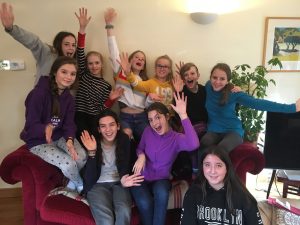
“Other adults are vital at this stage, teenagers need a village. Grandparents, godparents and experts. In the modern world we need to actively invite other adults in. This is why the pandemic was so disastrous for young people and they are now suffering more stress related issues and concerns than ever before.
Our children are needing to heal. These are normal and natural stress responses. Let’s help our children recover their equilibrium.”
Kim uses a simple and warm analogy to show us how to manage this growing up stage,
“When our children are very young, we hold their hand when we walk down the road. As they get bigger they might just walk by our side but then we take their hand again when we get to a road. With the online world we must metaphorically hold their hand. Go with them and show them what’s safe behaviour.”
In social media we must help young people recognise what’s healthy content and to take responsibility for the time spent looking at it. It is essential we spend time with them on it. We also need to be good role models, ensure we are using it healthily and think about what they see we’re spending our time on. Kim’s landmark course, Girls Journeying Together group addresses social media and its use in depth, as well as examining ideas of beauty, and key issues for young women such as starting periods and managing friendships.

Rites for Girls runs two threads of support for girls. A year long course called Girls Journeying Together – this brings together a group of girls on the cusp of adolescence to bond, learn about themselves and enter into this exciting time with their own rituals and support group. The second programme is Girls’ Net which was created in direct response to the mental health crisis exacerbated by the pandemic. It brings together girls and young women from around the world online and addresses issues they are struggling with over six weeks.
“Bring back the support young people need otherwise the well-being of our children suffer.”
Kim wrote her first book in between home educating her children,
“They’d be at trampolining and I’d sit in the van and write. I poured so much of my time and energy into it, I wanted to share what the girls had taught me.”
Kim is clear that her book is a resource for all parents, not just those of daughters. She hopes it will help change how they feel about parenting through the teenage years. It is a lovely book; warm and hopeful with practical advice. Much like Kim herself which is why I go on to ask her about what advice she has for us parents of daughters, how can we raise grounded young women with seemingly so many obstacles?
1. When parenting, step back and remember yourself at the age of your child. What was important to you? Think about the clothes you wore and the music you liked. This really helps tune us into what our child needs and helps us understand it better.
2. Give your full attention to them sometimes. Nothing boosts a child’s self-esteem more. (This is the first thing Kim talks about in her book and the ‘mother-daughter date’ is now in my diary regularly with both of my daughters and I cannot recommend it enough!)
3. Family meals are really important. The power of sitting down and sharing food together cannot be underestimated, even if it’s just once a week.
4. Kim’s top tip is to do something for yourself every day. Not just grab a cup of tea and a sit down but something that is meaningful to you. Do something real and nourishing – it will be different for everyone. We want to teach our girls to take care of themselves. Not just take care of other people. So let them see you taking care of you.
First published in The Green Parent Magazine 2023

To mark Children’s Mental health week, here are a few practical tips on how you can support your child’s mental health.
As parents, one of our most important roles is to support and nurture our children’s emotional well-being. With the increasing pressures and challenges of modern life, our children need us more than ever to help them navigate their emotions and develop resilience. We can do this through effective communication, setting boundaries, emotional regulation, and fostering self-esteem.

Give your child your full attention when they are speaking. Put away distractions such as your phone or TV and make eye contact. Show that you are listening by nodding and responding with comments like “I see” or “That sounds tough.”
Instead of asking questions that can answered with yes or no, ask open ended questions, for example ‘What was the best part of your day’? this allows your child to reflect on their day.
Encourage open and honest conversations by being open and honest yourself. Share your thoughts and feelings in an age-appropriate way, and let your child know that it’s okay to express their emotions.
When your child is dealing with a challenging situation or feelings, they could be emotional in their communication with you. If they are angry, don’t react by meeting them back with anger, meet them with curiosity and calm, wondering what has made them feel angry.
Acknowledge your child’s emotions and let them know that it’s okay to feel what they are feeling. For example, “It sounds like you are really frustrated. It’s okay to feel that way.”
Boundaries are essential for creating a safe and predictable environment for your child. Here are some tips for setting and maintaining boundaries:
Clearly communicate the rules and expectations to your child and be consistent in enforcing them. Consistency helps children understand what is expected of them and what the consequences are for not following the rules. Let your child be involved in any conversations about ‘House Rules’, as they need to be fair and apply to everyone.
While it’s important to be firm in setting boundaries, it’s equally important to be fair and understanding. Take the time to explain the reasons behind the rules and listen to your child’s perspective.
Giving your child choices within the boundaries you set can help them feel a sense of autonomy and independence. For example, “You can choose to do your homework now or after dinner.”
Helping your child learn to regulate their emotions is crucial for their mental health. Here are some tips for teaching emotional regulation:

Children learn by observing their parents. Model healthy coping strategies such as deep breathing, taking a break, or talking about your feelings. Your child will be more likely to adopt these strategies themselves. Children learn the most from watching you. If they see coping well in stressful situations, they are likely to manage them well too.
Create a calm and peaceful environment at home where your child feels safe and secure. This can include having a quiet space for relaxation and limiting exposure to stressful situations. Have limits on screen time for the whole family. Eat meals together, this is a great time to talk together!
Encourage your child to express their emotions in healthy ways, such as talking about their feelings, drawing, or writing in a journal. Let them know that it’s okay to feel and express a range of emotions. If you child struggles to express their feelings, name what you are seeing, for example, your fists are clenched and your shoulders are hunched, you look angry. This gives them the vocabulary to express how they feel and notice the sensations in their body.
Praise your child for their effort and hard work, not just their achievements. This helps them develop a growth mindset and understand that their value is not solely based on their accomplishments.
Encourage your child to take on age-appropriate responsibilities and make decisions for themselves. This helps them develop a sense of competence and confidence in their abilities. Children need to feel capable and useful.

Help your child identify and focus on their strengths and talents. Encourage them to pursue activities and hobbies that they enjoy and want to get better at.
When our children are being unlovable, is when they need the most love! Show your child that you love and support them unconditionally. Be there for them during difficult times and celebrate their successes. Your support and encouragement are crucial for building their self-esteem.
Supporting your child’s mental health is a continuous and evolving process. By maintaining open communication, setting clear boundaries, teaching emotional regulation, and fostering self-esteem, you can help your child develop the resilience and skills they need to navigate life’s challenges. Remember, your role as a parent is vital, and the love and support you provide are invaluable to your child’s mental well-being. Make sure you are taking care of your own well-being, as it’s hard to give, what you are not receiving yourself. As our founder, Kim McCabe says, ‘Put your own oxygen mask on first!’ Create practises and find the people, that support and resource you, so that you have the patience and energy to model this to your children.

Jayne Bond is a Girls Journeying Together Facilitator and Girls’ Net Mentor in the Bognor Regis area. To find out more about groups and taster please use the link below to contact her.

At the start of a new year, we can ask ourselves, “Do we really speak our truth?”
For many, the transition from one year to another is the perfect time to reflect. Before stepping over the threshold of a new year, it can be good to spend time celebrating the successes of the year gone by, but also honouring the hard and painful moments.
We can reflect on all aspects of our lives: our work, the things that bring us joy, and our relationships – with our family, colleagues, friends and most importantly, ourselves. After looking back, we can think about how we want to move forward, stepping into the new year with intention and purpose.
So we can ask ourselves: How will we show up for ourselves? How will we protect our peace, hold our boundaries and speak our truth? For women in particular, speaking up can be a hard one. Although we’ve come a long way when it comes to gender inequality, most women still suffer from the collective wound inflicted by patriarchal society which often includes a fear of speaking out, a fear of using our voice.

I can remember when it became hard for me to use my voice. It was when I was a teenage girl. Feeling brave, I could speak up, but only to myself or the people I trusted the most. Out in the world, I would be on guard. When something happened that didn’t feel right, I often found myself socially paralysed. Heat would rise in my body, including my face, which made me wish a hole would appear into which I could disappear. I would be searching for words that wouldn’t come; and not wanting to make the other person feel uncomfortable, I’d not say anything. I’d feel uncomfortable instead, with a throat that felt as if a vice was being tightened around it.
Over time, as I replayed the situation over and over in my head, words would well up from within me and gather right underneath that vice. More and more, pressing against each other, tumbling out of my inner knowing, desperate to be screamed into the silence I had created. But the vice would stay closed.

Girls can lose their voice before they enter their teens
Growing up today is particularly hard for girls. Add to that a huge life transition like puberty and it’s easy to see how a girl, and her voice, can get lost. Interestingly, many young children don’t have issues with speaking up and asserting themselves, boy or girl. We’ve all heard toddlers say “Hey, that’s my toy!” or “I don’t like this game, let’s play this instead.” Yet, when those toddlers grow up and enter puberty, their voice is silenced. Teenagers carry the burden of countless pressures and expectations and the need to fit in makes standing up for yourself difficult. It becomes hard to say, “I don’t want to go to that party” when everyone else is going. At that age, my own self-consciousness and lack of understanding of who I was, made me doubt myself and unsure whether or not I could trust my intuition. Even when I listened to the messages my body was sending me, I simply didn’t have the vocabulary to put words to the feelings and I lost my ‘voice’.
Many women and girls struggle with speaking up. When we have safe places to practice giving attention to how we think and feel, we can experiment with speaking our truth out loud.

Charlotte is a Trainer and Accredited Girls Journeying Together Facilitator. She runs groups in South East London and you can find more details here:

Nela knew she had to train as a Girls Journeying Together Facilitator from the moment she heard our founder Kim talking on a podcast (The Menstruality Podcast by Red School). She had been looking to create a course for girls growing up in Germany, prompted by her own daughter’s requests to make a ‘puberty course’ so that she could share her excitement about growing up with her friends. Nela, already working with and for women in Berlin, knew empowering girls was the next step for her. It was while researching content for creating this course she discovered it already existed – as Girls Journeying Together.
The stars aligned for Nela, during her research she noticed that one of our training webinars was running just 10 minutes later. She immediately registered and attended, and that was that,
“Yes you have to do it,” Nela’s inner voice told her. There were just two problems, time and money! Nela had been unwell in 2023 and had spent more time than she would have liked away from her family, now she was thinking about going away again.
“I had this big yes, do it! I was doing something that was meaningful for my power, strength and happiness and I was doing it for me as a mother, for the girls, and the world.”
Her husband and both children were so pleased that it was something lovely and were not concerned that it would be taking her away this time.
The next issue was money. Nela had been unwell and had used up all her savings. She knew this was something she had to do, so how to raise the money? The answer came in the form of a crowdfunding campaign which was incredibly successful. In just four weeks Nela raised the full amount for her training and a week later found herself on a plane from Germany to the UK to attend the first part of the programme.

So how did Nela crowdfund everything she needed to cover the cost of our training in just four weeks? I will share her top tips below. The whole process took about three months. Nela told me,
“Even if you have the money, the campaign is so worth it to build up the community.”
It seems that launching a crowdfunding campaign had a two-fold benefit. Nela found that whilst she was raising money, she was building a community of women and girls interested in her girls groups, as well as supporters of her work.
If you are unsure how crowdfunding works, it’s a simple process:
You find a platform that suits you, there are lots to choose from including Kickstarter, Crowdfunder, GoFundMe. You need to do your research to make sure their criteria is right for you and your campaign. Nela used Startnext which offered her two options – a target that you could aim for but didn’t have to meet, or a target that if you didn’t reach all the money was returned to the investors. Her intention was to use the ‘safe’ first option and top up with help from her parents or the bank if necessary, but friends persuaded her to go for the second. Hitting the target or bust approach means the pressure is on but people are keener to see you reach it. It turned out to be the right choice as supporters were cheering her on to reach that target to do the training. Nela made a pitch video for the campaign as well as gathering and making ‘goodies’ to give to supporters who invested.

For supporters, there were also two options – either to just give a donation or to invest in return for something. Nela offered virtual high fives for five Euros as her cheap offering but then as the sums went up supporters were given physical items in return. These ranged from homemade mother-and-daughter bracelets, an e-book she had written (the most popular option), up to buying your daughter or another girl her place on Girls Journeying Together in advance. In this way she already had two girls booked onto her first group for girls who might otherwise not be able to attend. Nela launched her campaign with a personal video on social media, and a countdown, and off it went…
Nela is now entering the second year of the training, and launching her first Girls Journeying Together group this spring. We will keep you posted on her journey.
In the meantime, here are Nela’s top tips for launching a crowdfunding campaign.
Visit Nela’s finished campaign:
https://www.startnext.com/die-maedchen-bande
If one woman can raise everything needed to train with us, so could you!
Why not come along to our training taster day in London on February 3rd. For just £65 you can experience our incredible training and see why it inspires such commitment and passion from so many women.
For more details and information about bursary places please email info@ritesforgirls.com or visit the booking page: https://forms.gle/cppmqMp75Mi9G8Wb7

Being relatively new to Rites for Girls I have been intrigued to find out more about our Ambassador, Golda Rosheuvel and what brought her to support our work. I was lucky enough to have a conversation with her last week and came away feeling so inspired by her passion and commitment to the well-being of girls and our training programme for women.

Golda is a beloved UK television and film actor and known for her powerful roles. I was keen to find out how she had heard about our work at Rites for Girls. Had she been looking for a cause to support alongside her acting work? To my surprise, it was through an informal chat that Golda came to hear about us. Sitting next to the Chair of Rites for Girl’s Non-Exec Board, Karen, at Wimbledon just 18 months ago they got talking and Karen mentioned our work which made Golda want to know more.
“It just sparked a real interest, a real memory of being adolescent, of being young and of needing something like that and I thought I want to be involved with that, I want to support that.”
Golda told me it was the impact of Karen’s words that really stayed with her that day (although she reassured me that they both enjoyed the tennis as well).
“I think it was that connection to my younger self, my younger self literally leant forward and went Gold, you need to hear more about this. That’s the thing that really resonates for me with Rites for Girls, is that I needed something like that when I was that age, and it would have so helped me to have that support.”

Golda went on to talk about the landmark programme we run, Girls Journeying Together and how wonderful it is for the girls participating to, “have those hands to hold, having that kindred spirit and that understanding that: life is difficult at the moment and I’m not quite sure why.”
Golda really understands that growing up can be challenging and that as a preteen herself she could have benefited from this sort of support.
Golda had the opportunity to meet a group of our girls who were brought together from different groups, some at the beginning of the year-long journey whilst others having completed the programme.
“I met the girls shortly after we discussed it at Wimbledon and what I really got from them was sisterhood, which I’m really strong on. I have amazing female friends, and I like to have that connection and that power and that understanding, that energy.”

“In the older girls you saw that confidence and that power that they have for themselves and for each other. It was a real gentle, serene confidence.
They are already a group, it doesn’t matter that they are from different circles, they all had this core understanding and belief in themselves and each other.”
“That we understand each other, there’s a kinship there. What struck me when I met the girls is that they’re going to have that for the rest of their lives. That’s incredible. Wherever they are in the world. There will be that connection for them.”
“If we can have more of that and support Rites for Girls to create more of this connection then the world will be a better place as far as I’m concerned.”
“I think the safety of Rites for Girls, to be able to express the struggles of adolescence, that change that happens. To be able to express that with other girls is fantastic, it’s so needed in the world. We need more of it. The more we can really share and communicate their story to other people. To have a wider understanding of the world and their part in it.”
It was incredible to see what an impact meeting the girls has had on Golda and how important she sees the roles of the facilitators in this. She likened it to two teachers she had when she was growing up and how they influenced her.
“They were really instrumental in me having a place at school, me knowing that I had this place I could go to, I was really good at.”
She talked about how the guidance of role models for girls can support an individual by just being themselves, “These two women really were – they did sports and drama, they were there prominently in my life. I was always fascinated by their strong personalities and the way they empowered those around them.”
Golda also talked about the influence they still have on her as an adult and as a successful actor working on the set of a film. She told me, “The environment has to be really positive and really safe where every single person comes with their best foot forward and we support them and celebrate and everybody has a chance to do their best best work and I ran that 10 weeks (of filming) exactly like that and I think that’s what I got from those women.”

It’s inspirational speaking with her and it’s wonderful to hear that she has found her own power and a drive to support others through these early mentors,
“I believe that now I have a calling to create space for people to do their best work, for people to shine. That’s what I want to do in my work.”
What about other women though, those who want to support girls but feel unsure, how can we help them shine? Golda didn’t even have to pause to answer this,
“There’s nothing, what you come is with yourself, you come with yourself and that is the truest form.”
“That’s what you are teaching the girls to find their truest form to understand their true selves and empower them. You encourage the facilitators to come with their true selves, not putting on something else. I think it’s really honest and really beautiful that everyone is different, and they bring different things. From their community, from their past, from their religion, from their race, from their sex. Everything is there to be gifted – so it’s not difficult when you have that mindset it’s really natural. You are bringing yourself.”
“I came out of that session with the girls, and I was so full of energy and empowerment and questions and inquisitiveness. I felt really energised and I smiled for about two hours. I think it was my preteen going ‘mate yes’ and adult me going ‘yes, we did that’. The whole thing is respectful, and you come out respecting yourself – your 12-year-old and your 54 year old.”
It was amazing to hear how Golda understood the ethos of Rites for Girls straight away. The power of our girls’ groups and the instrumental role of our trained women who just bring themselves, as they are to the training and in that way can learn to support, empower and connect girls to grow up in a safe space. I am so looking forward to hearing more from Golda and seeing her develop this Ambassadorial role over the course of 2025 – watch this space and shine.
Details about training to be a facilitator can be found on this website at:
https://www.ritesforgirls.com/facilitator-training/
and if you are looking for a girls’ group for your daughter visit:
https://www.ritesforgirls.com/girls-journeying-together/
All images by Jeff Moore

We often hear comments about how infants bring a sense of wonder back into our lives. With teenagers, however, the focus tends to be on how they irritate us and less on how their behaviour can remind us of what is truly important in life.
What is your teen doing that you haven’t done in a long, long time – and maybe wish you were?

– taking myself and my feelings really, really seriously.
– fighting for my right to live how I want.
– caring a great deal about my friends.
– questioning authority.
– seeking excitement.
– experimenting with how I look.
– wondering who I am.
– taking risks.
– sleeping until I no longer feel tired.
– eating what I really fancy.
– courting new friendships.
– testing limits.
– acting on impulse.
– learning by doing.
– going for what I want.
– winging it.
– giggling.
– trying new things.
– railing at life’s injustices.
– believing that a better world is within our grasp.
Thinking of the young people in your life, what can you add to this list of important things that teenagers do?

We asked on social media what people enjoyed about their preteen and teen years and the comments echoed the above list. Here are just a few -please do add yours.
“When people ask if you could go back to being a teen, what would you do differently – having a teen is your chance to do just that, guide them past the mistakes you made, and support them with their own.” Larissa, Norfolk
“I LOVE this age!
So much positivity and hope at this age. Raw emotions that show vulnerability that as adults we try and suppress. Nervous excitement about new things and the look for encouragement from us as parents or teachers.” Lizzie, Suffolk
“I absolutely love her confidence, the ability to see her own beauty and worth and celebrate her attributes without holding back.” Lynsey, Merseyside
The teenage years have their unique challenges, for the teens and their parents. As adults in a teen’s life, we can understand and support them better when we remember what it was like to be a teenager ourselves.
Our teens are great teachers. They remind us of some of the most important things in life. And they feel good when we tell them how much we learn from them. Often those things that irritate us most, could inspire us too.
We’d love to hear what your teen does that you’d like to do too.

What a great film – if you’re over eighteen! There’s so much to relate to – the rage that’s triggered by nothing much, the tears that rise up from no-where, and the anxiety. Oh, the anxiety of being a teenager. But I was watching from the point of view of the preteens, who will make up much of the audience, and it was frankly terrifying. Is this going to happen to me? What’s the upside to this inside?
Where in the film were the new emotions that also visit us during adolescence: exuberance, invincibility, and curiosity? Puberty brings emotional gifts as well as challenges. Remember those times when life seemed limitless and amazing, and you just felt so full of your hopes and dreams you could burst. At the same time, with greater self-awareness comes increased self-consciousness, and with that embarrassment, envy, and anxiety. And the teen brain is under reconstruction, so all feelings are felt more intensely. Of course, those feelings don’t last, no feeling does. Feelings are like the weather, they come and then they pass, especially if we don’t suppress them. However, teens don’t necessarily have the tools to deal with this intensity, and they act out, or seem not to be themselves – for a bit. All normal. And mostly manageable when you’re in it. But I don’t want children to dread the teen years (or their parents) and this film reinforces the message that teenage years are hell, and crippling anxiety runs the show.

So, it concerns me that this is the biggest grossing animation, released at the start of the summer holidays viewed by millions of pre- pubescent kids and their parents.
I talked to my 20-something daughter-in-law who loved it. She thought it was a wonderful representation of what it’s like to go through your teens. The friendship dilemmas, the random fury, and that pervasive anxiety. It was entertaining for her to see it characterised by the battle of emotions in this way. Affirming of her experience of the teen years.
By contrast my ten-year-old niece, who also loved it, found it confusing. Her Dad helped her to make sense of it by explaining that the girl lost her sense of self when puberty hit but found a new one. She liked the new characters in the girl’s head, but she didn’t seem to ‘get it’. Yet. She will…

At Rites for Girls we run girls groups for preteen girls, and when talking about growing up I notice many are still age-appropriately naïve. “I’ll never drink, take drugs, have sex before marriage, get piercings or tattoos, dress like that!” They might, later on, but they’re not there yet. And hopefully each girl will feel equipped to make her own choices about these things. And there’s no hurry.
So, after seeing this film how can we chat with our preteens to help them look forward to what lies ahead? And prepare them too.
Here are seven pointers:
Kim McCabe, Founder and Director, Rites for Girls

The idea of a Mother-Daughter Date is for you to spend time alone together, once a month for a few hours with your daughter. You might view the school holidays as a greater opportunity to spend more time together or an extra complexity as you try to juggle work, childcare and possibly the needs of more than one child.
Continue reading
Mothers form a circle around the girls’ group and go on a journey together too
Continue reading