

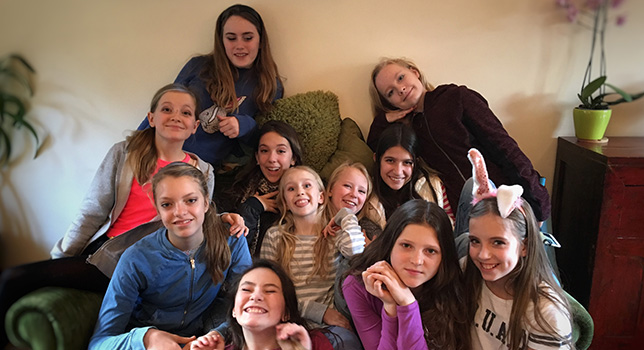



Teens – you gotta love ‘em!

Teens get such bad press
I think they’re are terrific.

They’re a bit challenging like toddlers – asserting themselves and pushing the boundaries, but very lovely with it.

How is it that we accept the noise and the mess and the tantrums of toddlers but complain bitterly about the noise and the mess and the tantrums of teens?

We could be more understanding.

❡   They are working out who they are – whilst under immense pressure to perform at school, match up to impossible ideals, and find their place amongst their peers.

❡   Their brains are reforming – and they are less in charge of that prefrontal cortex where good decisions are made.

❡   They are becoming more self-conscious – just at a time when their bodies erupt in spots, curves, and hormone confusion.

If you think back to your own teens, remember the vulnerability.

No matter how tough they may seem, our teens need us to remember who they are, deep down.

A teen is a person who wants to love and be loved.

Teens – we gotta love ‘em!

ornament_3-2s

Teen’s have a great way of reminding us about some important things here

Posted on 10 May 2013
Musings: Parenting girls

Be the first to leave a comment

What does it take to belong?

“Why can’t our family just be like everyone else?”

“I just want to be normal.”

“If you come to pick me up, don’t wear that coat / outfit / hair style.”

The cry of many a teenager!  They strive for uniformity.  But they also want to feel unique.

ornament_acornsm

Feeling more self-aware than ever before, often makes a teen not want to stand out.  At the same time, they crave the affirmation that special attention brings:

“I want to be me… but I want that me to be like everyone else.”
“I want to be special and unique… but I don’t want to be different.”
It’s confusing.

Peer pressure is to conform to the values of the peer group.  School pressure is to conform to the culture of the school.  Parental pressure is often to conform to the values of the family.

It is impossible for a child to be like their friends, and as the school wishes them to be, and comply to family expectations, and still discover who they are.

Kids can experience great conflict when they’re trying to fit in at school and at home – and still be their own person.

But fitting in isn’t the same as belonging.  Belonging is about being yourself first and then discovering who you like to hang out with, what you enjoy doing, whilst still being yourself.  Fitting in is tying yourself into knots to try to be what you imagine others want you to be.  You lose yourself.

Some children draw inside and seem to comply, others will rebel; both these reactions are acts of self-preservation but neither lead to a true expression of self.  Both hurt.

ornament_acornsm

You gain a sense of belonging when you let people see who you really are.  You can only do that if you believe that you are acceptable as you are – with all your faults, strengths, and quirky habits.  If our children don’t believe themselves to be acceptable as they are, then they are prone to try to fashion themselves into something other than their true self.  This can continue their whole lives.

The trouble is, many parents feel that it is their job to mould their children.  We don’t trust children to be good, honest, upstanding people.  We believe that we must make them so.  Too many childhoods are spent feeling chastised, criticized, guided and shaped.  Many children start to believe that they need to be different to be acceptable.  When these children grow up they continue this process internally, being self-critical and trying to transform themselves into someone they believe they should be.

Children need us to respect who they actually are – and not try to change them.

They need us to champion their individuality.

How do you do this for your daughter?

ornament_acornsm

Posted on 3 May 2013
Musings: Parenting girls, Parenting teenagers
Tags: ,

Just 1 comment

Rites for Girls has been shortlisted for the BritMums’ Brilliance in Blogging

Thank you to all my regular readers, those who visit silently and those who converse with me, for making my website one that you value.

I wrote a piece recently about how to help our children to develop who they are and what they love – to encourage them to find their passion.

For me, creating this website, and working with mothers and daughters in groups is exactly that – my passion.  As I poured energy into providing opportunities for my own children to explore and discover what they love, it felt important to do the same for myself.  This is the result.

All the hours that I pour into writing for my website, I just long for it to reach as many mothers and daughters as would be inspired and supported by what I publish.

If you felt like voting for Rites for Girls then please click here and scroll down to question 17, the ‘Commentary’ shortlist.

Many thanks, Kim

ornament_acornlarge

Posted on 30 April 2013
Musings: Parenting girls

Just 1 comment

Parents’ hopes and fears

What is your vision for your daughter?

Many parents start by saying that they just want their children to be happy.
Healthy and happy.

We might go on to say that we want our child to be joyful, to love life, to have fun, to know what she wants and have the confidence to pursue that, to feel fulfilled, to have deep friendships, be open-hearted, kind, and generous, to love and feel loved, to love herself, and to be happy.

But she might be happy just eating chips and chocolate and skipping school.

What then?  Do we want our child to be happy – but only in a way that we are comfortable with?

Do we think we know better about where true happiness lies?  Perhaps we do.

ornament_4_green-2s

I hear children struggling under the pressure to realize the goals that are set for them.  Not a great deal of happiness seems to come in achieving them either.  I could say the same of many adults.  Too often we are trained to lose touch with who we are, and what we want, as we strive to meet what is expected of us.

Here’s what many teens think their parents want from them:

Do well in school
Then get a good job
Succeed in chosen hobbies
Eat sensibly
Go to bed on time
Have friends who are a good influence
Do as told – help out, clear up, be nice
Act responsibly
Don’t be confrontational
Be amenable and in a good mood
Stay clear of drugs
Wait for sex
Oh, and be happy

This is a very different list from the one that parents give for their true aspirations for their child.

It is much harder to confer confidence and self-love, than it is to focus on exam results and messy bedrooms.  Tune into the air space between you and your daughter.  Are you helping her to figure out what she loves?  We all slip into “Have you done… ?” and “Shouldn’t you…” but if we really mean what we say when we list our aspirations for our children, we will also be nurturing the acorns of their dreams.

It is a delicate balance between guiding our children towards healthy behaviour and positive aspirations, and allowing their own natural inclinations and passions to emerge to guide them.

ornament_4_green-2s

Childhood is not the time to fill our children’s heads with information.  Notice how they will naturally inform themselves of whatever they need to know in their own area of interest.  In this Wikipedia-age that part is easy.  What is more elusive, and more precious to find, is what makes their hearts sing. Then we serve them best by enabling them to be resourceful – to sift through facts, feel confident about their ability to learn new things and develop their own opinions, and listen to what they feel to be right.

Get behind your child’s passions, or get out of the way so they can.

Even if their fascinations seem fickle, you prioritizing them gives your child the sense of how important it is to follow her own heartbeat.  Trust that within her are the impulses to seek out what gives her pleasure and to discover where her talents lie.

The clearest way of communicating this to your child is by how you live your own life.  Are you doing what you are good at?  Are you giving time to doing what you love?

ornament_4_green-2s

Although I believe that the best development is from the inside out, rather than outside in, it can be hard to trust that a child will turn out okay without our moderation.  And yet, we want them to go out into the world with a strong sense of self, motivation, and ability to take responsibility.  So at what age do we start trusting them to do this?

This is so much easier if we understand and approve of our children’s dreams, but whatever they are, if we truly want a happy child we will support them in whatever it is that they love.

She may want to draw and dance rather then solve simultaneous equations
She may want to sponsor a panda rather than learn how to play tennis
She may want to play her guitar and make up songs all day
She may want to plant flowers to save the bees rather than study stigma and stamens
She may want to fiddle about on her laptop connecting with people
She may want free range in your kitchen to make chocolate cake and chicken curry
She may like to earn money and spend all day Saturday in town spending that money

A child who has been allowed to develop her true self
is more likely to be a happy self – right through into adulthood.

What gives your child joy and energy?

ornament_4_green-2l

Posted on 26 April 2013
Musings: Parenting girls, Parenting teenagers
Tags: , , , , , , , , ,

Just 1 comment

Birds and bees tangled in the web

Are you worried about online porn?

Well, don’t worry…

Do something!

On TV women are smoother skinned, slimmer, and sexier than ever before.  In magazines they reveal ever more, and what they reveal is ever more perfect.  Online, well, online almost anything goes.

Some say that any child on the web is only two clicks away from adult pornography, and many do inadvertently come into contact with explicit images at a young age.  In the UK the average age of first exposure is 11 years and research in one local authority found that by the age of 13 years 100% of boys had accessed online porn and 50% of girls.  Many of these girls said they were pressurized to look at pornography by the boys.

Online pornography is many children’s main sex education.

Access is easy, but the quality of course is dubious.
Online porn is graphic and degrading.  It is often violent against women.

ornament_pinkleafinglarge

So what is pornography doing to our children?  Pornography affects our children’s attitude towards sex.  It influences their beliefs about what is acceptable sexual behaviour.  It distorts their views on relationships, and violence, and gender roles.  It shapes boys expectations of girls and the female body.  It damages body image.  It confuses young people’s understanding of consent.  Viewing online porn can become a compulsion.  The biggest users of online pornography are boys aged 12 to 17.

Unfortunately the problem can be invisible to parents.  Our children’s access to online pornography is difficult to monitor and problematic to restrict.  Children want somewhere quiet to do their homework, which now often requires a computer, so these often end up in their bedrooms.  Smart phones are with them everywhere.  Even if you protect your internet at home, their friends may not be protected.

The European Parliament looked to ban online porn.  Iceland is banning it by filtering at source.  The UK government decided not to.

Does filtering work?  Some would say that safety filters do not solve the problem anyway and that many children become adept at circumventing them.  Certainly it is worth applying filters to prevent inadvertent access by our youngest ones.  Older children need something more.  They need our adult input to help them to navigate this new virtual world.  Although they may have greater expertise at surfing it, we still have much wisdom to offer about how to live healthily within it.  Their curiosity is natural.  We must not make them feel wrong for being inquisitive.  But they also need to know the risks, the harmful effects, how to resist peer pressure, and how else to find out what they are curious to know.

ornament_pinkleafinglarge

Increasingly prevalent is peer-to-peer content, generated by teens and shared between them.  Sexting – sending sexually explicit messages or photographs – is commonplace.  Girls report being placed under pressure by boyfriends to send photos of themselves.  For many young people sexting is fun and they see no harm in it.

The best way to protect your daughter is to make sure that she has people to advise her; people she would turn to when she is not sure about something.  Who does your daughter listen to and respect?  Ultimately she is going to have to make many of her own decisions, but making sure that she has you, or an auntie, or a teacher, or an older teen to talk things through with, will better equip her to make the right decisions for her.

So, in the end, the best kind of filtering is not software, but human – where they filter what they have encountered through a trusted adult, and gain the ability to self-regulate their exposure.

So, to keep our kids safe – keep the lines of communication open.  Rather than cracking down, help your children to make the right decisions for themselves, as you really can’t be at their side the whole time.

And don’t be afraid to turn your router off at night!

ornament_pinkleafinglarge

Related Posts Plugin for WordPress, Blogger...
Posted on 18 April 2013
Musings: Parenting teenagers
Tags: , , , , , , , , , , , ,

Just 1 comment